
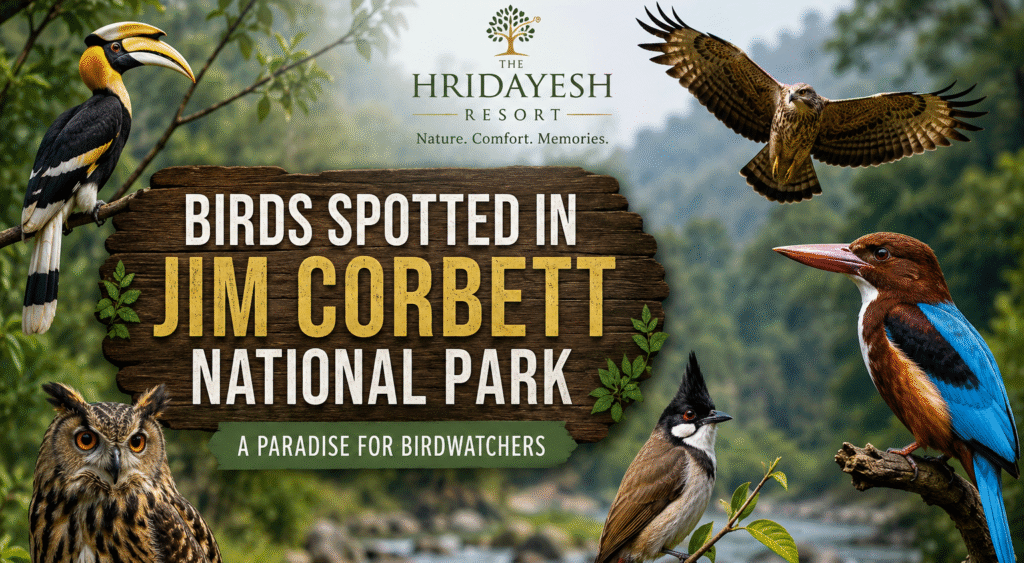
Most people who visit Jim Corbett arrive hoping to spot a tiger. Most of them leave talking about the birds.
It’s not hard to understand why. Corbett is home to over 600 bird species, raptors soaring above the canopy, kingfishers flashing colour along the riverbanks, hornbills crossing the treeline with a wingspan wide enough to stop mid-conversation. You don’t need to be a serious birder to feel it. You just need to be somewhere quiet enough to notice.
The Hridayesh Resort sits on 8.25 acres of landscaped grounds along the banks of the Kosi River in Dhikuli which means birdwatching here doesn’t wait for a safari. It starts at the water’s edge, before breakfast.
This guide covers the 10 most remarkable birds you can spot around Jim Corbett, where to find them, and the best time to look.
Why Jim Corbett Is a Birdwatcher's Paradise
Corbett’s terrain does something most reserves can’t: it combines dense sal forests, open grasslands, riverine belts, marshlands, and Himalayan foothills within one contiguous landscape. Each habitat draws different species. The variety is staggering.
The park’s position near the Himalayas also makes it a seasonal corridor for migratory birds, particularly in winter, when species from Central Asia and beyond pass through or settle in.
Productive birdwatching zones within and around the park include:
- Dhikali Zone deep forest, excellent for raptors and forest birds
- Bijrani Zone mixed forest and grassland, strong for hornbills and eagles
- Jhirna Zone open terrain, good year-round
- Sitabani Forest Reserve quieter, less traffic, rich diversity
- Kosi River Belt riverside species: kingfishers, fish eagles, storks
- Garjia and surrounding forest dense cover, excellent for owls and serpent eagles
The Hridayesh Resort’s location in Dhikuli puts you within reach of the Kosi River belt and the Garjia forest area, two of the most productive birding corridors in the region.
10 Birds to Look for Around Jim Corbett
1. Crested Serpent Eagle
One of the most commonly spotted raptors in Corbett, the Crested Serpent Eagle commands attention the moment it appears above the canopy. Its call a sharp, repeating whistle often signals its presence before you see it.
What it looks like: Dark brown plumage, broad wings, prominent crest, yellow facial skin and eyes.
Where and when: Best spotted soaring above sal forest canopies during early morning. The Garjia forest area is a reliable location.
2. Great Hornbill
There are birds you observe, and then there are birds that announce themselves. The Great Hornbill is the second kind. Its wingspan can reach well over a metre, and when it glides between trees, the wingbeats produce a deep, rhythmic whooshing sound you often hear before you see it.
What it looks like: Massive yellow beak with a curved casque on top, black and white wings, bright yellow neck.
Where and when: Found in the dense forest patches around Bijrani and Garjia. Early mornings between 6–8am are your best window.
3. Himalayan Bulbul
A favourite with photographers for its pointed black crest and reliably cheerful song. The Himalayan Bulbul is vocal and active, often found near forest edges and open gardens including resort grounds in the Corbett area.
What it looks like: White cheeks, black crest, brownish body.
Where and when: Forest edges, wooded gardens, and riverine areas throughout the region.
4. Pallas’s Fish Eagle
A rare and highly sought-after sighting. The Pallas’s Fish Eagle draws serious birders to Corbett specifically it is one of the more spectacular birds of prey associated with the park’s river systems.
What it looks like: Large wingspan, distinctive white head and neck, powerful hooked beak.
Where and when: Spotted near rivers and larger water bodies where it hunts fish. The Kosi River is a known habitat. Best observed from a quiet position near the riverbank during morning hours.
5. White-throated Kingfisher
One of the most vividly coloured birds in the region and among the easiest to spot, it perches openly on branches and wires near water, making it accessible even for first-time birdwatchers.
What it looks like: Bright blue wings, chocolate-brown body, white throat, vivid red beak.
Where and when: Rivers, ponds, open fields, and riverbanks. The Kosi River belt is excellent for kingfisher sightings throughout the year.
6. Collared Falconet
India’s smallest bird of prey, the Collared Falconet is easy to overlook until you know what to look for. Its compact size surprises most first-time visitors who spot it, as it doesn’t fit the typical silhouette of a raptor.
What it looks like: Very compact, white underparts, dark upper body, small hooked beak.
Where and when: Perches on exposed branches and tree tops at forest edges. Patience is required for a clear sighting.
7. Red Junglefowl
The wild ancestor of domestic chickens, Red Junglefowl are a Corbett regular. They move through grassland clearings and forest edges in small groups, particularly in the early morning before the day heats up.
What it looks like: Brilliant red and orange plumage in males, long tail feathers, distinctive crowing call.
Where and when: Grasslands and forest clearings. Early morning safaris offer the best sightings.
8. Oriental Pied Hornbill
A close relative of the Great Hornbill and equally striking. The Oriental Pied Hornbill is found in fruiting trees and forested areas, often in pairs.
What it looks like: Black-and-white body, curved ivory-coloured beak, distinct casque.
Where and when: Fruiting trees around forested areas, particularly in zones with mixed vegetation like Bijrani.
9. Brown Fish Owl
A dream sighting for many birdwatchers large, impressive, and rarely seen by those who don’t know where to look. The Brown Fish Owl is most active at dusk and through the night, often roosting near water during the day.
What it looks like: Large orange eyes, prominent ear tufts, brown mottled plumage.
Where and when: Near rivers and water bodies, roosting in large trees. Dusk is the most productive time. Patience and quiet movement are essential.
10. Black Stork
An elegant winter visitor that adds to Corbett’s already remarkable avian diversity. The Black Stork is a migratory species, arriving from its breeding grounds in Europe and Central Asia during the cooler months.
What it looks like: Glossy black plumage with a white belly, long red legs, long pointed beak.
Where and when: Wetlands, riverbanks, and shallow water areas. Most commonly spotted between November and February.
Best Time to Visit for Birdwatching
Birdwatching in Corbett is rewarding year-round, but different seasons offer different experiences.
Winter (November – February) The peak season for birdwatching. Migratory species arrive, the weather is clear and cool, and visibility in the forest is excellent as the canopy thins. The Black Stork and Pallas’s Fish Eagle are winter visitors.
Summer (March – June) Bird activity intensifies around water sources as temperatures rise. The Kosi River becomes a focal point for species like the White-throated Kingfisher and various egrets. The strong season for photography light is clear and birds are visible in open terrain.
Monsoon (July – September) The forest becomes lush and green. Many resident species begin breeding, and their behaviour in territorial calls, courtship displays becomes more visible. Not the traditional safari season, but rewarding for the patient birdwatcher.
Practical Tips for Birdwatching in Corbett
Start before sunrise. Bird activity peaks between first light and 8am. Arriving at the water’s edge or forest margin before the sun rises gives you the most productive window of the day.
Carry binoculars. A quality pair changes what you’re able to see. Many birds in Corbett perch at height or distance binoculars turn a flash of colour into a sighting.
Wear neutral colours. Dull greens, browns, and greys blend into the forest environment. Avoid bright clothing that can alert birds before you’re within sighting range.
Stay quiet and move slowly. Most missed sightings come from noise and sudden movement. The more patient you are, the more you see.
Bring a camera with a zoom lens. Corbett’s light, especially in winter and summer mornings, is excellent for wildlife photography. A 300mm or longer lens is ideal for bird photography in this terrain.
Birdwatching from The Hridayesh Resort
The Hridayesh Resort sits on 8.25 acres of landscaped grounds along the Kosi River in Dhikuli and for birdwatchers, that location matters.
The Kosi River corridor is one of the most active birding zones in the Corbett area. Species like the White-throated Kingfisher, Pallas’s Fish Eagle, and various river-associated birds are documented along this stretch of water. The Garjia forest area, which the resort is positioned near, is known habitat for the Crested Serpent Eagle and the Brown Fish Owl.
The resort’s Riverside Luxury Villa puts guests directly at the water’s edge, a natural viewing position for early morning bird activity along the river. The open landscaped grounds, set within a larger forest and riverine environment, extend the birdwatching experience well beyond the safari itself.
You don’t need a guide or a schedule to start. An early alarm, a pair of binoculars, and a quiet walk toward the river is enough.
Frequently Asked Questions
1. How many bird species are found in Jim Corbett National Park?
Jim Corbett National Park is home to over 600 bird species, making it one of India’s premier birdwatching destinations.
2. What is the best time for birdwatching in Corbett?
Winter (November to February) is peak season, with migratory birds arriving and excellent visibility. Summer (March to June) is strong for photography. The monsoon months bring breeding activity among resident species.
3. Are migratory birds found in Jim Corbett?
Yes. Corbett’s proximity to the Himalayas makes it a seasonal refuge for many migratory species. The Black Stork and Pallas’s Fish Eagle are among the notable winter visitors.
4. Can beginners enjoy birdwatching in Corbett?
Absolutely. Many of Corbett’s most spectacular birds including the White-throated Kingfisher, Red Junglefowl, and Himalayan Bulbul are highly visible and easy to spot without specialist knowledge. Binoculars and an early start are all that’s needed.
5. Which area of Corbett is best for birdwatching?
The Kosi River belt, Bijrani zone, Garjia forest area, and Sitabani Forest Reserve are among the most productive. The Dhikuli area, where The Hridayesh Resort is located, provides direct access to the Kosi River corridor.
Plan Your Stay
📞 Call us: +91-88690-73337 / +91-88698-73337
📧 Email: reservations@thehridayeshresorts.com
🌐 Visit: The Hridayesh Resorts