
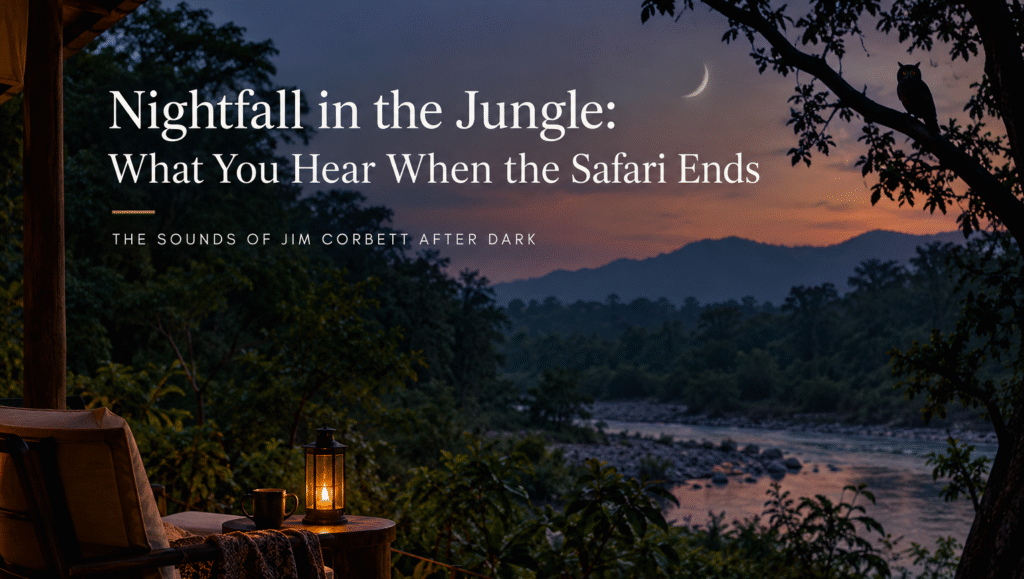
You came to Corbett to see a tiger.
For a few hours, you did what everyone does. You scanned every bend in the track, held your breath at every rustle and listened for the one alarm call that would stop the jeep. Then the vehicles turned back, the sun slipped behind the sal trees, and the day felt finished.
It wasn’t. The forest was only changing languages.
After a Jim Corbett safari ends, the forest stops being something you look at and becomes something you listen to. If you’ve ever stepped off a jeep and reached straight for your phone, this is what you were scrolling past.
Why the Jim Corbett Jungle Sounds Different at Night
By day, you are part of the noise. Engines, conversation, camera shutters, the rush to reach the next waterhole. Even the forest’s own sounds compete with whatever you are searching for.
At dusk, that noise stops, and nothing replaces it. That is when you realise the forest never went quiet. You were simply too busy looking to hear it.
The jungle hasn’t become quieter. You’ve started to listen differently.
Cool, still evening air helps too. Once the day’s wind drops, sound tends to carry further, so a call you would never notice at noon can seem to arrive from nowhere.
Four Sounds to Listen For After Dark (and What They Mean)
You don’t need to name every call. But knowing what you’re hearing turns background noise into a story.
1. The insect chorus: the floor of the night
Crickets and cicadas set a steady rhythm that seems to come from every direction at once. It swells in the warm months and thins out on cold winter nights, so a September evening and a January one in Corbett will not sound alike.
What it tells you: listen for the moments it stops. A sudden hush in one patch often means something has moved nearby. And if you are travelling from Delhi NCR in winter, expect a quieter chorus and more room to hear everything else.
2. The nightjar: the sound that doesn’t seem to belong
Nightjars are among the first birds to start calling around dusk, often from open ground and clearings. Their call is sharp, repeated, and almost mechanical, often compared to stones being tapped together. If you hear it, the nightjar is telling you the day birds have handed over to the night shift.
3. Owls: the call you can’t place
Owls range from small, chattering owlets to larger species with deep, carrying hoots. Along rivers like the Kosi, a brown fish owl is one possibility. You will rarely see the bird. That is the point: you meet the wildlife in Jim Corbett through its voice first, and sometimes only through its voice.
4. Alarm calls: the only sound with a message
A deer’s sharp bark or a langur’s whoop is the call that silences a safari jeep by day. After dark it travels through still air just the same.
What it tells you: something has startled an animal. It does not tell you what. Resist the urge to decide it was a tiger; a rustle or a call is not proof of one. The honest answer is usually “we’ll never know”, and that is part of the pull.
Where the Kosi River Changes the Soundscape
Not every night sound comes from an animal. A breeze moves through the leaves, tall branches creak against each other, and where there is water, the river adds a constant low layer beneath everything else.
Along the Kosi River, which flows beside The Hridayesh Resorts in Dhikuli, that layer is part of the evening. When the water is audible from where you are sitting, it will change with the flow and your distance from the bank. Move a little away from the bank and the water recedes while the insects and birds come forward. Two spots on the same property can sound like two different forests.
Does the Jungle Really Go Silent at Night?
Not quite. A completely silent jungle is more romantic than realistic. Even when the forest feels still, insects are calling, leaves are moving and animals are passing through their habitats.
What changes is the combination. Some daytime birds fall quiet and nocturnal species become more active. Wind, temperature and season all alter what you hear and how far it carries. A clearing sounds different from dense woodland, and the riverbank sounds different from both.
There is no single soundtrack to Jim Corbett, and no checklist to tick off. You do not need to hear a particular animal to have an authentic experience of the forest. You only need to be there, paying attention, and keeping your distance from the wildlife.
Things to Do After a Jim Corbett Safari: A Ten-Minute Listening Plan
Think of this as a short routine, not an itinerary.
- Be settled before the light goes. Dusk is when the handover happens. Step off the jeep, skip the phone check, and be outdoors while the sky turns from gold to grey.
- Put the phone away for ten minutes. No music, no videos, no notifications. Notice which sounds are continuous, which arrive suddenly, and which seem to come from far away.
- Choose your spot. By the water for the river’s voice, in open space for wider sound, under trees for rustles and creaks. At The Hridayesh Resorts, the 8.25-acre grounds sit on the Kosi in Dhikuli, so the river is part of your evening rather than a drive away. If you want it as close as possible, ask for the Riverside Luxury Villa when you book.
- Keep the night dark. Keep outdoor lighting low, skip loud music, never use torches or flash to hunt for animals, and never leave food outside. If you move beyond your accommodation, follow the property’s guidance and use authorised routes only.
- Go back out once more before bed. Have dinner at Unwind, with its open show kitchen, or a drink at Elixir, then step outside again. The forest you hear at the end of the evening is not the one you heard at dusk.
You Came for the Tiger. Stay for the Sound.
A safari gives you the sighting, or the story of the one that got away. The evening gives you something no safari can schedule: the forest on its own terms.
You may never learn where every sound came from. You may not see another animal tonight. But you will have done something most weekend itineraries leave out. You will have listened.
So book the safari. Then protect the evening that follows it.
You came for the tiger. Don’t be surprised if it’s the owl you never saw that you end up telling people about.
Book your safari for the day and keep your evening for the forest. Among nature resorts in Jim Corbett, The Hridayesh Resorts sits on the Kosi River in Dhikuli, with 8.25 acres of grounds, dinner at Unwind and drinks at Elixir. Ask for a riverside stay and give the evening ten quiet minutes.
Frequently Asked Questions
Is Jim Corbett silent at night?
No. Insects, birds, moving leaves, and, near the river, flowing water continue after dark. What changes is the mix of sounds, which shifts with the season, the temperature, and the habitat around you.
What can you hear in Jim Corbett at night?
Commonly, an insect chorus of crickets and cicadas, nightjars, owls and animal alarm calls, with the sound of the Kosi River where water is nearby. Exactly what you hear varies by season and by where you are.
When is the best time to listen to the Corbett jungle at night?
Dusk and the hour or two after it are a good place to start, because that is when the day-to-night handover is most noticeable. Warm months bring a fuller insect chorus; cold winter nights are quieter, which can make individual calls easier to pick out.
Plan a Corbett weekend that doesn’t end at the gate
📞 Call us: +91-88690-73337 / +91-88698-73337
📧 Email: reservations@thehridayeshresorts.com
🌐 Visit: The Hridayesh Resorts