
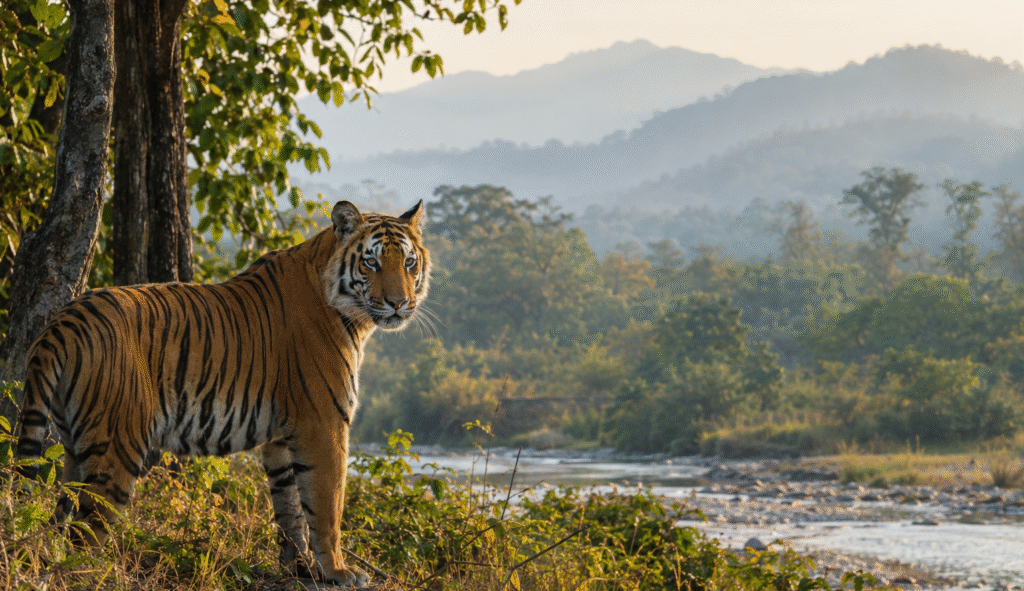
In 1907, a tigress in Kumaon was blamed for the deaths of 436 people, by the count most often cited. Villagers across the region lived in fear of her. The man who finally tracked her down was a Nainital-born hunter named Jim Corbett.
Almost three decades later, that same man helped make the case for protecting a whole stretch of forest for the animals he had once hunted.
That forest is now Jim Corbett National Park. If you are driving down from Delhi for a weekend in the wild, you are about to enter a park named after a man-eater hunter. The reason it carries that name is the most interesting thing about it.
The Hunter the Villages Called For
Jim Corbett was born in Nainital in 1875 and grew up between the hill town and Kaladhungi, the family’s winter home in the foothills below it. He learned the forest the way the villagers did, by listening. An alarm call, a pugmark in the dust, the sudden silence of langurs: he read them like sentences.
That skill is why villagers and officials turned to him when a tiger or leopard began killing people. The Champawat tigress was the most notorious, and he stopped her in 1907. In the decades that followed he was called to other man-eaters, among them the tigers of Chowgarh and Mohan, the Thak tigress and the leopard of Rudraprayag.
What set him apart was what he refused to do. Corbett did not treat every tiger as a villain. Man-eaters, he observed, were often animals that had been injured or could no longer hunt their usual prey. A healthy tiger living in the forest was not his quarry.
It is a distinction worth carrying into the forest with you. The tiger you hope to see is not a monster and not a trophy. It is an animal that needs space, water and prey, and, as Corbett came to see, a great deal of protection.
From Rifle to Camera: How His View of the Tiger Changed
As roads, settlements and clearing spread across the foothills, Corbett noticed a pattern. The danger to tigers was not only a handful of bad encounters. It was the steady loss of the forest they lived in. Fewer places to hunt meant more animals pushed towards villages, and more trouble for everyone.
He began putting his energy elsewhere: watching tigers, photographing and filming them, writing about the forest with obvious affection, and lending his voice to the push to protect it. He never disowned his past as a hunter. He had simply seen what it cost.
Chhoti Haldwani: Conservation That Began with a Wall
To understand Corbett’s idea of coexistence, visit the village he built. At Chhoti Haldwani, near Kaladhungi, he created a model village for its residents and raised a stone wall around it to keep wildlife out of the crops. It was a practical answer that protected farmers and animals instead of forcing a choice between them.
Today you can walk the village heritage trail, which passes the wall and ends at his old home, now the Jim Corbett Museum. His book My India describes the people of this village, and it is the best companion for the walk.
It is a small idea, and it still frames the biggest question in conservation: protection only lasts when the people who live beside the forest share in its benefits.
Why India’s First National Park Carries His Name
In 1936, a tract of forest in the foothills of Uttarakhand became Hailey National Park, named after Sir Malcolm Hailey, then governor of the United Provinces. It was India’s first national park. Corbett, whose knowledge of the terrain was unmatched, helped make the case for it.
After independence, Corbett left India for Kenya, where he died in 1955. In the mid-1950s the park, which had briefly been renamed Ramganga National Park, took his name. A hunter of British descent became the namesake of a national park in independent India, an unusual honour that recognised what he had done for its forests and not only how he had hunted in them.
The Park Where Project Tiger Began
In 1973, Corbett was chosen as the launch site for Project Tiger, India’s flagship effort to protect its tigers and their habitat. Today the wider Corbett Tiger Reserve shelters sal forest, grassland and river, and with them elephants, deer, leopards, crocodiles and hundreds of bird species.
That range of life is the point. A tiger needs more than somewhere to hide. It needs prey, water and room to move. Save the tiger and you have to save everything it depends on, which is the conclusion Corbett reached on his own, long before it became policy.
Read Him Before You Go
The best preparation for a Corbett weekend is a paperback. Man-Eaters of Kumaon is the gripping one, full of long nights and slow trails. My India is the warmer one, a portrait of the villagers he knew. Read either and the forest sounds different when you enter it. A rustle becomes a question, and a bird’s alarm call becomes information.
Plan a Corbett Weekend Around His Trail
Corbett is roughly five to six hours by road from Delhi NCR, which makes it an easy long-weekend escape. A trip built around his story can feel very different from a safari checklist.
- Start at Chhoti Haldwani. Walk the heritage trail and visit the Jim Corbett Museum in his former home. Do this before your safari, so you enter the forest knowing whose world it was.
- Take the safari slowly. A tiger sighting is never guaranteed. Corbett’s own approach was to read the forest through what it told him: tracks, calls, the way deer froze. Treat that as the point of the drive, and any tiger as a bonus.
- Travel the way the forest needs you to. Follow safari rules, keep your voice down, carry your waste out and buy from village businesses near the park.
For the evenings, The Hridayesh Resorts sits on the Kosi River in Dhikuli, on 8.25 acres of grounds. Choose an Executive Villa (450 sq ft), a Riverside Luxury Villa (1,000 sq ft) or the Royal Suite (1,500 sq ft). Dinner is at Unwind, whose open show kitchen makes the meal part of the evening, followed by a drink at Elixir. After a day spent in Corbett’s world, the quiet of the river outside is the right way to end it.
Planning A Corbett Trip?
Explore our riverside villas and plan your stay at The Hridayesh Resorts.
📞 Call us: +91-88690-73337 / +91-88698-73337
📧 Email: reservations@thehridayeshresorts.com
🌐 Visit: The Hridayesh Resorts
What Jim Corbett Would Want You to Notice
You may or may not see a tiger. Most visitors don’t, and the trip still counts. What is worth noticing is how much has to be going right for a tiger to exist at all: the prey, the water, the unbroken forest and the villages that choose to live alongside it.
Corbett’s legacy is not simple. He was a product of his time, first famous for the rifle. But he also became one of the early voices for protecting what he knew so well, and his life is proof that understanding can change a person’s whole relationship with nature.
Corbett spent his early years learning how to find tigers. He spent his later ones making sure there would still be forests for them to live in.
Frequently Asked Questions
Who was Jim Corbett?
Edward James “Jim” Corbett (1875–1955) was a hunter, naturalist, author and photographer born in Nainital. He became famous for stopping man-eating tigers and leopards in Kumaon and Garhwal, and later became an advocate for protecting wildlife and forests.
Why is Jim Corbett National Park named after him?
The park was renamed in his honour in the mid-1950s, shortly after his death in Kenya in 1955. The name recognises his role in supporting the creation of the park and his contribution to wildlife protection in the region.
When was Jim Corbett National Park established?
It was established in 1936 as Hailey National Park, India’s first national park. It was later renamed Ramganga National Park and then Corbett National Park.
What is Jim Corbett’s connection to Project Tiger?
Corbett National Park was the launch site of Project Tiger on 1 April 1973, India’s national initiative to protect tigers and their habitat.
Can visitors learn about Jim Corbett’s life today?
Yes. The Jim Corbett Museum is in his former home at Chhoti Haldwani, near Kaladhungi. A village heritage trail nearby passes the stone wall he built to protect crops from wildlife.
How can travellers support conservation in Corbett?
Follow safari regulations, avoid disturbing wildlife, reduce and carry out waste, respect forest boundaries and support local businesses that encourage responsible tourism.
How far is Jim Corbett from Delhi?
Jim Corbett is roughly 250 km from Delhi, around five to six hours by road depending on traffic and your route. It suits a long weekend or a three-day break.