
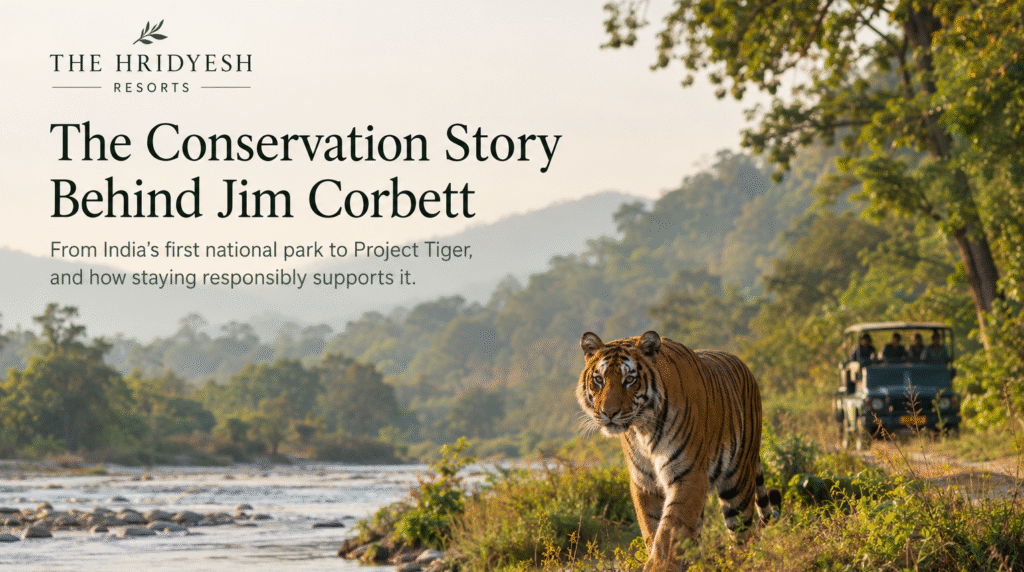
Sunday evening, back in Delhi. Someone asks the question every Corbett visitor gets asked: “Did you see the tiger?”
If the answer is no, the trip didn’t fail. It means you spent a weekend inside a forest that still has the space to be wild, and that is rarer than a sighting.
Corbett became India’s first national park in 1936, long before safaris, resorts or Instagram. Since then, decades of decisions about land, water, prey and people are the reason tigers still live here at all. The sighting is the last link in that chain. Your weekend is the next one.
This is the story behind the forest you’re about to enter, and the small choices, from the safari jeep to the place you sleep, that decide whether it stays that way.
Corbett Was Protected Long Before It Became a Destination
In 1936, a stretch of Kumaon forest became India’s first national park. It was named Hailey, after a Governor of the United Provinces, at a time when hunting and habitat loss were putting real pressure on the region’s wildlife. After independence the name changed, and in 1957 the park took the one it carries today, in honour of Jim Corbett.
Corbett is an unlikely namesake. He made his name hunting man-eating tigers and leopards in the Kumaon hills, but over the years his relationship with the forest turned from hunting towards protecting it. His books carried these Himalayan foothills to readers across the world, and today his name is tied as closely to conservation as it is to the landscape.
The next turning point came in 1973. Tiger numbers across India had fallen sharply because of hunting, habitat destruction and other pressures, and the country launched Project Tiger to create dedicated reserves where the species and its habitat could be properly protected. The programme was launched from Corbett, and Corbett Tiger Reserve was one of its first nine.
What changed in 1973 was the idea itself. Protecting a tiger stopped meaning protecting a tiger. It meant protecting everything the tiger depends on.
The Tiger Is the Headline. The Forest Is the Story.
A tiger can’t survive on a forest alone. It needs territory, water and prey such as deer and wild boar, and those prey need grass and cover to live. Elephants, birds, reptiles and insects are all threads in the same fabric, and the Ramganga River and the forests around it hold much of it together.
For you, that changes how a safari reads. The spotted deer at the edge of the grassland, the elephant herd at the river, the stretch of sal forest where nothing happens for twenty minutes: these aren’t filler between sightings. They are the reason a sighting is possible at all.
Corbett shelters Bengal tigers, Asian elephants, leopards, spotted deer and sambar, gharials and crocodiles, and a long list of foothill and Himalayan birds. Each one is part of the answer to why the tiger is still here.
Tourism Can Protect a Forest, or Quietly Wear It Down
A weekend in Corbett quietly pays for a chain of livelihoods: the naturalist who reads pugmarks, the driver who knows which track the sambar alarm-calls on, the family-run eatery near Ramnagar. When people earn a living from a standing forest, the forest gains defenders who aren’t on any government payroll. That is the real case for tourism, and the reason it only works when it’s done carefully.
The same visitors can also wear a forest down. Here’s what a sighting-first safari costs: a trip spent waiting for one animal, jeeps bunching up at every bend the moment a tiger is rumoured, and engines idling in front of a creature that was only trying to cross a road. The forest pays for that disturbance. So do you, because the best moments in Corbett rarely come from the closest view.
Wildlife isn’t a performance, and a national park isn’t an entertainment venue.
A few habits make the difference, for you and for the forest:
- Follow the rules and your guide. Stay on designated routes and follow forest staff. They read this forest better than any itinerary does.
- Never feed wildlife. It changes natural behaviour and creates dangerous encounters between animals and people.
- Keep it quiet. A quiet vehicle gets to watch natural behaviour. A noisy one watches animals leave.
- Take everything back out. Plastic and packaging have no place in a protected forest.
- Let distance be part of the experience. An animal behaving naturally from far away beats a close view of one you’ve disturbed.
And accept the one rule the forest sets for itself: sightings are never guaranteed. It runs on its own schedule.
Where You Sleep Is Also a Conservation Decision
A stay near Corbett is more than a bed between safaris. Resorts employ local people, buy local goods and services, work with local guides and drivers, and introduce visitors to the region’s natural and cultural heritage. They also decide, every day, what happens to water, waste, energy and plastic in a sensitive landscape.
A resort on a river carries a particular responsibility, because what it does with water, waste and light eventually reaches the Kosi. At The Hridayesh Resorts, 8.25 acres of mango groves sit on the banks of the Kosi in Dhikuli, with low-rise buildings in earthy materials shaped by local craftsmanship.
Conservation in Corbett has never been the forest department’s job alone. Officials protect the habitat, researchers study it, local communities live beside it, guides and drivers shape how visitors see it, and resorts help set the tone for how a stay looks. Visitors decide the rest, one choice at a time.
A Corbett Weekend That Isn't a Checklist
Book the safari, but don’t let it be the whole trip. Give one afternoon no target. Walk down to the Kosi. Visit the Garjiya Devi Temple, which sits on a rock in the middle of the river. If you have time, see the Corbett Museum, in the bungalow where the man behind the park’s name lived, looking for more places worth a stop? Our guide to offbeat places near Corbett has a few.
Then let the evening slow down. At The Hridayesh Resorts, that means a Riverside Luxury Villa to come back to, dinner at Unwind, and a drink at Elixir, with nothing left on the schedule.
So if you’re planning a Corbett weekend from Delhi, plan it around the forest, not around the sighting. We’d be glad to host you in Dhikuli, on the banks of the Kosi.
And when you’re back in Delhi and someone asks whether you saw the tiger, tell them what you did see: the river, the birds, the sal forest, a place still wild enough to need protecting.
The best souvenir from Corbett isn’t a photograph of wildlife. It’s a greater understanding of why the forest needs to remain wild.
Plan a trip to Jim Corbett with The Hridayesh Resorts
📞 Call us: +91-88690-73337 / +91-88698-73337
📧 Email: reservations@thehridayeshresorts.com
🌐 Visit: The Hridayesh Resorts